TRIESTE: THE ITALIAN-CHINESE OPERATIONS OVER THE INTERNATIONAL FREE PORT
Political Attack on the Port’s Defenders

Analysis by Paolo G. Parovel, English version by Silvia Verdoljak
Trieste, 26 September 2026 – The Italian political circles that support the illegal penetration of Communist China (the PRC) in the management of the international Free Port of Trieste are increasing the pressure on our organizations, the citizens, and the enterprises of Trieste who oppose this threat with a tenacious, courageous legal battle.
But defending them is not a local question, or a marginal one. Because the illegal penetration of the PRC in the management of the international Free Port of Trieste is a serious strategic threat to Euro-Mediterranean economic and political balances.
Violation of Treaties.
Those Italian-Chinese operations over the international Free Port of Trieste are illegal because they violate the legal status of Trieste, established with the 1947 multilateral Treaty of Peace with Italy and with the subordinate quadrilateral 1954 Memorandum of Understanding, both of which are in force (U.S. Department of State, Treaties in Force – A List of Treaties and Other International Agreements of the United States in Force on January 1, 2026).
Indeed, the city and Free Port of Trieste remained under Italian sovereignty for only 27 years, from 1920 to 1947.
The 1947 Treaty of Peace with Italy establishes Trieste as a small sovereign State with an international Free Port: the Free Territory of Trieste – FTT, which has bordered Italy since 1947, and Slovenia since 1992.
The FTT has a Provisional Regime, which since 1947 has been entrusted to the Governments of the United States and of the United Kingdom, and with a 1954 MoU they have sub-entrusted its temporary civil administration to the Italian Government (not to the Italian State) in compliance with the Peace Treaty.
Since 1955, the military defense of Trieste has been entrusted to the Supreme Allied Commander Europe (SACEUR) who responds directly to the President of the United States.
The political authorities responsible for the conduct of the temporary civil sub-administration of Trieste, however, are violating the Peace Treaty and the MoU to simulate that Trieste and its international Free Port are still part of the Italian State.
The support of communist China.
The PRC supports their simulation so that the Italian Government allows it to use the Free Port of Trieste without the direct control of the International Commission established by the Peace Treaty (Annex VIII, Arts. 21, 22 and 23), which doesn’t include China.
The International Commission is the body vested with the authority to prevent abuses of the special regime of the Free Port of Trieste, which has economic and strategic roles different from those of any other free port.
A special Free Port regime.
The regime of the international Free Port of Trieste allows for the loading, unloading, warehousing, trading, and the manufacturing of the goods of all States without customs duties or charges.
The Peace Treaty also assures those goods freedom of transit by railroad to and from the Free Port of Trieste through all States, and forbids them to artificially divert those goods to other ports.
This makes its economic and strategic role for international trade extraordinary, even decisive when it comes to trade between Central Europe, the Mediterranean, Suez, and beyond.
Confidential contacts and official agreements.
Contacts between Italian and PRC interests for agreements over the Free Port of Trieste developed through confidential contacts from the late ‘90s to early 2019.
In March 2019 the Italian Government signed official agreements with the Chinese Government, which would have handed over the logistics control of the international Free Port of Trieste to State-owned companies of the Chinese Communist Party (LINK).
The US later successfully obtained that the Italian Government put a stop to those agreements over Trieste, because they constitute violations of the 1947 Peace Treaty and of the 1954 MoU.
Covert operations.
However, certain Italian circles are continuing covert operations to extend the PRC’s control over the international Free Port of Trieste.
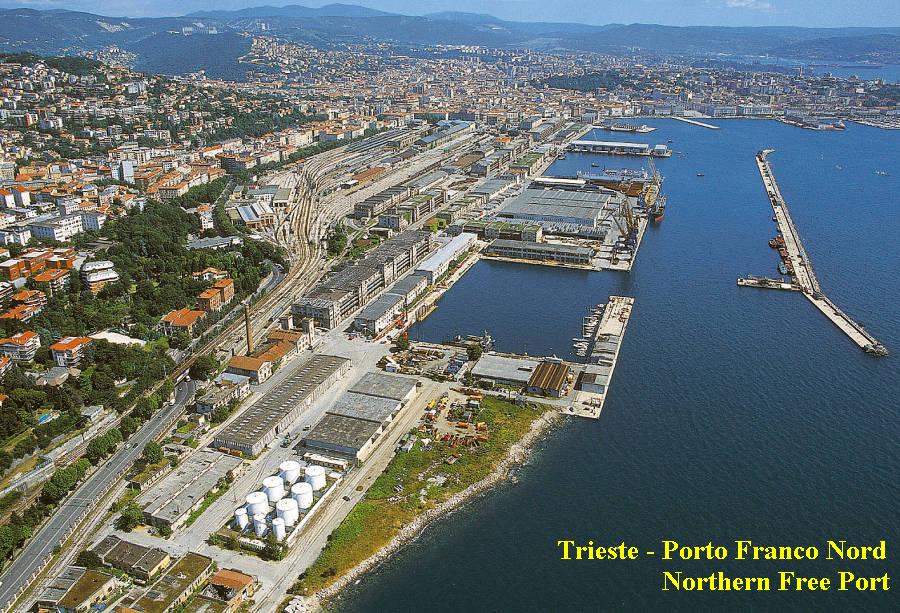
Indeed, they use fronts and corporate shareholdings, as well as supporting a massive fraud organized by Italian politicians to privatize and sell half of the international Free Port of Trieste: the Northern Free Port.
This is a fraud that also violates the rights of all States and their enterprises over that port area.
Direct legal defense.
In December 2019 two organizations and 241 citizens, residents, and enterprises from Trieste and other States activated the direct legal defense of the international Free Port (LINK).
They are the same two organizations that since 2017 have brought the Italian Government before Court in two civil proceedings regarding taxation rights in Trieste, which were joined by 1100 citizens, residents, and enterprises.
Just like in the two previous legal actions, the claimants had requested Italian judges to review and to order compliance with the laws in force and to put an end to their violations.
The outcomes of the three lawsuits should have been certain, because the international Treaties and Agreements establishing the legal status of Trieste and of its international Free Port are also laws in force of the Italian State with Constitutional primacy.
Political and judicial repression.
The three lawsuits are fully grounded in fact and law, and they have made evident significant corruption and illegal behaviors of the Italian administration.
But the promoters of the three lawsuits are also the only effective defense of Trieste and of its international Free Port, because the local establishment is ruled by active and passive accomplices of the aforementioned illegal behaviors.
For those reasons, the Italian authorities reacted to the three lawsuits with political and judicial repression, violating the principles of democracy and of the rule of law.
On the judicial level, in all three lawsuits, and at all stages of the proceedings, the judges in charge complied with the official requests of the Avvocatura dello Stato (the Legal Service of the Italian State).
The State’s Legal Service openly demanded that those judges refuse to review and to order compliance with the laws in force by falsely declaring their absolute lack of jurisdiction, to declare, against fact and law, that the invoked international obligations and rights do not exist and, finally, to punish the claimants, ordering them to bear enormous court fees and fines.
Because of this, the final result is a whole series of politically motivated repressive judgments.
On the political level, the Italian authorities have been using press silence against the claimants when it came to information that favors them, while the press has run campaigns threatening them, libeling them, as well as spreading false information and accusations against them.
A new attack.
At the beginning of September, the claimants were attacked once again with a violent campaign run by the local newspaper.
The newspaper attempted to discredit them, to scare them, and falsely reported that those judgments have put a permanent end to the legal battle in defense of the Free Port, ruling that it belongs to the Italian State.
To discredit the claimants, the local newspaper falsely presented them as tax evaders who only deny Italian sovereignty to avoid paying the due taxes to the Italian State.
In order to scare them, the newspaper threatened them, claiming that Italian authorities are going to seize their personal assets or their enterprises.
The newspaper later intensified its attack by publishing a list of 550 names of people and enterprises that had joined the lawsuits to identify them as tax debtors, ordered to pay legal fees, as well as political enemies of the Italian State.
With the intimidatory publication of those 550 names, the newspaper has committed an open violation of Regulation (EU) 2016/679 on the protection of personal data (Arts. 29 and 35).
The unfairness of such a politically motivated aggression is as evident as is its seriousness, and it allows those 550 persons and enterprises to seek compensation for the damages that the newspaper has caused to each of them.
It remains to be understood why this new, intense aggression against those defenders of those defenders of the rule of law took place now.
The urgency to sell.
The latest politically motivated aggression against the defenders of the international Free Port of Trieste coincides with attempts to accelerate the illegal sale of the Northern Free Port, much awaited by Chinese interests.
The current formula of the operation envisions a project financing between the Municipality of Trieste and a group of Italian enterprises, which would then resell areas and port facilities as private properties with concessions of coastal areas enjoying the Free Port regime attached.
And the urgency to sell is so pressing that the Mayor has gone as far as wishing death upon the environmentalists who are delaying the sale with an administrative lawsuit.
The main reason why the illegal sale is so urgent is because those scandalous judgments of the Italian judiciary have become definitive evidence of the violations denounced by the claimants.
And there are violations of international Treaties and Agreements that establish sovereignty rights over Trieste, as well as the rights of all States and their enterprises over the Northern Free Port.
The legal battle moves to a higher level.
This means the legal battle moves to a higher level, going beyond a direct confrontation with the judicial authorities of the Italian State to enter the assessment by international observers, who have been paying close attention to this situation through our analyses.
The bluff of domestic judgments.
The legal efficacy of those scandalous Italian judgments, instead, remains a bluff, because no domestic judgment (even from the Italian Supreme Court of Cassation) can have legal effects on obligations and rights established by international Treaties and Agreements.
And this means that any attempt to act upon those judgments, treating them as sources of legal effects on obligations and rights established by international Treaties and Agreements would only constitute a flagrant violation of the same Treaties and Agreements, and as such it could be challenged.
Direct sources of information.
We would like to bring to our readers’ attention (especially fellow journalists) the main sources of information, in English and in Italian, regarding the Question of Trieste and its international Free Port, which are fully available online.
In particular, these is a systematic, updated review of laws (LINK), a complete analysis of the false, opposite claims (LINK), an analysis of the liabilities of Italian public officers (LINK), and the Writs of Summons of the lawsuits regarding taxation (LINK), the inapplicability of the Italian VAT in Trieste (LINK), and the lawsuit regarding the international Free Port that also challenges the illegal agreements with the PRC (LINK).
Enjoy!